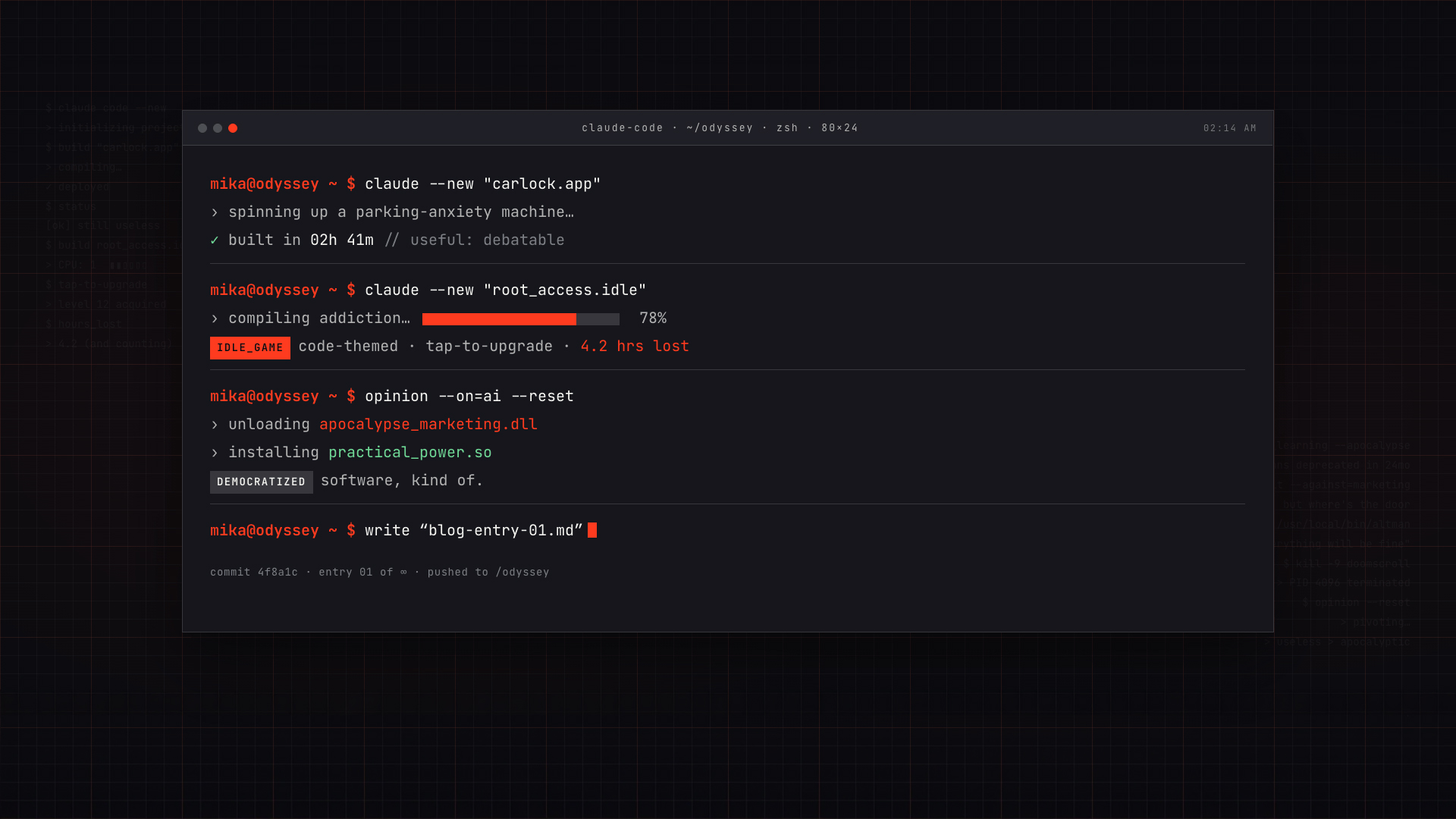
I have a somewhat pathological obsession with the constant churn of social media and tech headlines. Because of that, I’ve been tracking the trajectory of artificial intelligence for years—and to be perfectly honest, my perspective has been far from optimistic. It certainly doesn’t help that the industry giants and their perpetually online CEOs keep reinforcing what I’d call a fairly cynical, albeit common, viewpoint.
Sam Altman writes essays calling for a total restructuring of society to handle the impending irrelevance of human labor¹. Anthropic’s Dario Amodei pens manifestos detailing the absolute upending of global economics and biology over the next decade². And let’s graciously ignore Musk’s twisted take on “Free Speech” for a moment. These figures constantly lecture us on how AI is destined to tear up our social fabric—a world where every junior role is replaced by autonomous agents currently busy explaining to your grandmother that a simple reboot fixes Windows. None of them seem particularly interested in dedicated reflection on how to foster genuine enthusiasm, or even basic tolerance, for a tool capable of such massive upheaval.
The cherry on top: OpenAI recently purchased TBPN³—(yes, a podcast). As TheVerge’s Editor-in-Chief Nilay Patel so perfectly put into writing/speaking and video(ing?)⁴, the whole industry seems to have such an immense disconnect to the rest of their species that acquiring some daily tech talk show just to hype your own brand feels like a seriously bizarre fix for a massive gap. They seem convinced that widespread public backlash is merely a symptom of a flawed marketing strategy (honestly, wtf).
§ 01Something Cracked
So believe me when I say this: I came into this primed to stay cynical. And yet—my inner tech-enthusiast lizard brain has stumbled onto something that feels somewhat untethered from the usual doomer outlook.
It’s the most captivating, shiny new toy ive laid hands on in years. And I know how dumb that sounds given that it’s already been out for months, covered on every podcast, with everybody having vibe-coded their way into bankruptcy by now.
I am, of course, referring to Claude Code.
Here’s why that matters from where I’m sitting: my day-to-day involves wrestling with monstrous node trees in DaVinci Resolve or obsessing over signal chains in Logic Pro just to get a project out the door. It’s a friction-heavy, hyper-precise environment where one wrong click or routing error breaks the entire render. So when I tell you something shifted, it’s not coming from someone who’s been waiting for a magic textbox—it’s coming from someone who knows what real software friction actually feels like.
Obviously I didn’t spend 20 of my oh so precious Euros on Claude Pro just for the selfless task of forming an opinion. I wanted to play. And that I did.
§ 02Experiment One: CarLock and the Useless Utility
Like with any other empty Textbox I can ramble into, in the hopes of making everything without doing anything, my very reasonable move was telling Claude to make me an app that probably no other human on this planet would find useful or even worth existing. And frankly, I’m not sure I’d really be able to defend it.
So, picture the ad in your head.
Have you ever had a car? Perfect.
You’re not the best at remembering normal stuff? Perfect.
Then this app is what you need.
No, I’m not talking about a parking spot tracker. CarLock is THE app for people who, on a minute to minute basis, forget if they really did lock their car.
And yes you guessed right—the day after I finished it, I forgot about it. It now lives in my “I-Don’t-Feel-Like-Deleting-All-These-Apps-I-Never-Use” section on my phone.
There’s a truly jarring, almost hysterical irony to all of this. The tech elites constantly lecture us that this omnipotent AI is poised to restructure the global economy. Yet, instead of witnessing the apocalypse, I’m sitting at 2 AM furiously yelling raw, disjointed commands into a terminal, begging a state-of-the-art machine to micromanage my own ADHD parking anxiety. The contrast between Silicon Valley’s doomsday marketing and me building a useless, hyper-specific app just to remember if I locked my car doors is honestly laughable.
§ 03Experiment Two: Weaponizing Addiction (ROOT_ACCESS)
After this first Monday evening down the drain I got a bit more ambitious.
I really love Idle Games. And even though I hate playing games on my phone apart from long train rides or flights, when I first discovered my total playtime on Egg Inc. I felt a level of shame others might only feel when noticing they fell down a rabbit hole of watching reddit-stories on TikTok, or watching carpets being deep cleaned for 3 hours (yes, also a fault of mine).
So the very obvious thing for me to do was create my own. Minus the eggs.
And yes I see the very uncreative thinking I did next.
Looking at the Coding Agent I was using, I let it create a code-themed idle game.
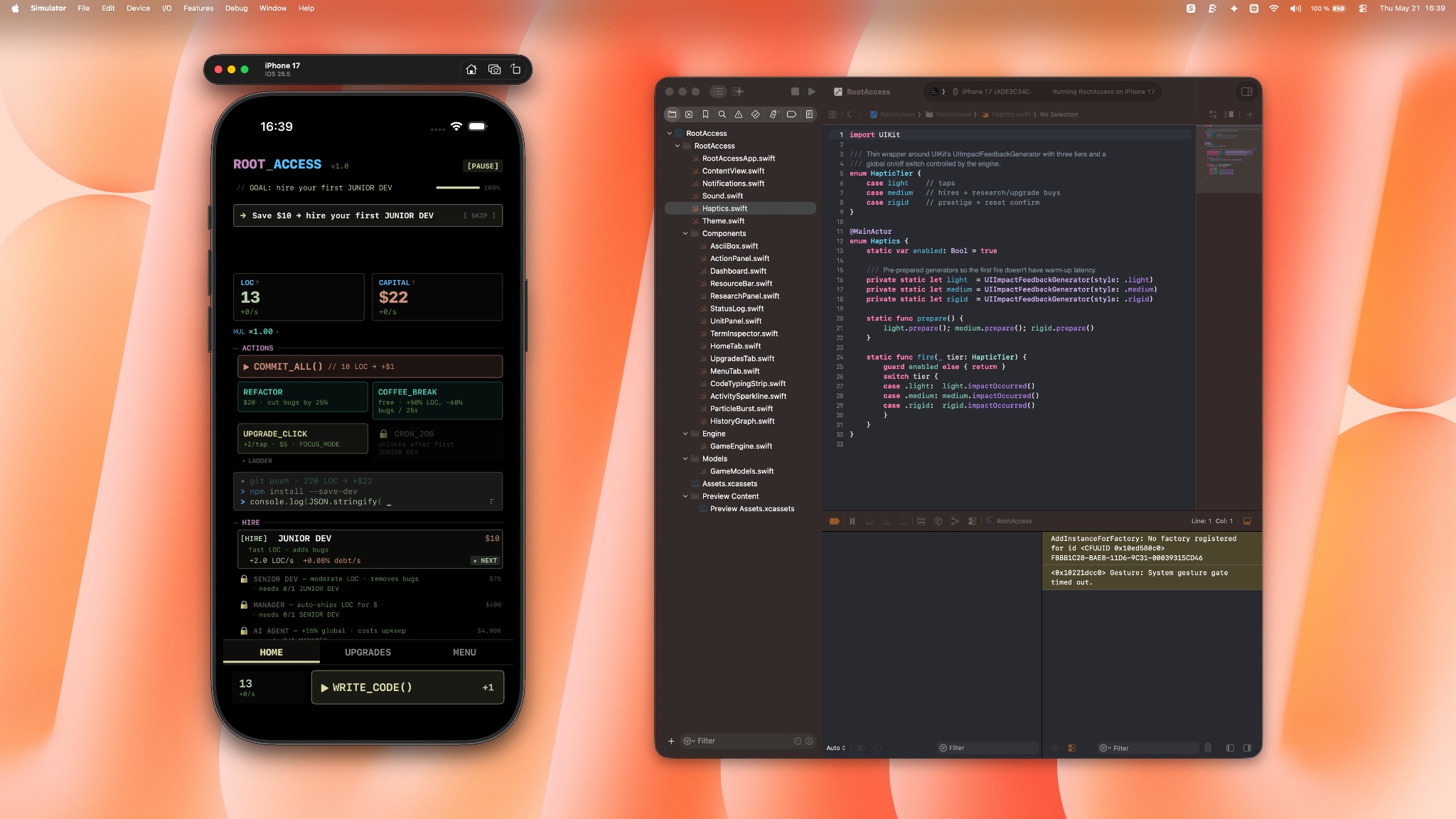
I’m not going to go into detail about the game itself—I’m aware enough to know these kinds of games aren’t fundamentally new or original in any sense. What I’ll focus on is two things: man are those things powerful, and I think I just got addicted to making an addicting game even though I sincerely despise being on my phone too long at a time.
§ 04What This Actually Means
Look, I spent months soaking in the hype cycle—endless podcasts and tech-bro threads—about how Claude Code and OpenAI’s latest offerings are supposedly reinventing the digital wheel. But even after all that mental preparation, it’s become painfully clear that my initial take was a massive, somewhat embarrassing, understatement of how much this actually shifts the ground beneath our feet.
To be fair though: this isn’t quite the frictionless utopia the marketing implies. Equipped with these latest instruments—provided you possess the capital, the surplus of hours, and the saint-like tolerance required to repeatedly inform an LLM that its logic is failing—you can embark on twenty-plus digital scavenger hunts to finally drag your concept into reality. And the tools won’t fix you while they’re at it. CarLock didn’t cure my forgetting; no diet app will actually force you to stick to a diet. You’re still you on the other side.
But the barrier for entry? That has effectively crumbled. The technical expertise once needed to manifest a nebulous concept into something functional is virtually absent. You shout a few disjointed commands into the digital ether and, before you know it, you’ve spiraled into a multi-hour obsession with your own custom-built distraction. It renders the act of shelling out thousands for a bespoke website, or subscribing to some hyper-specific finicky utility, almost entirely obsolete.
And that—after months of cynicism, after every doomsday op-ed and every TBPN acquisition—is the part I genuinely can’t dismiss. We might be witnessing a real democratization of software, pivoting away from a handful of developers dictating tools to millions who merely tolerate them. We’re entering an era where, save for essential social hubs, we can simply build our own tailored versions of daily utilities to suit our personal whims. All for the low, low price of only twenty bucks to a single new silicon-valley overlord… at least for the time being.
So here’s where I land. Of all the AI-powered technologies that have been aggressively shoved down our digital throats over the last few years, Claude Code is the first one I think could actually do something beneficial for the rest of us—not for the people on stage announcing it, but for the person at the keyboard. It’s the first one, in my book, that has earned a right to stay.
Sources:
¹ https://moores.samaltman.com/
² https://www.darioamodei.com/essay/machines-of-loving-grace
³ www.theverge.com/ai-artificial-intelligence/906022/openai-buys-tbpn

No comments yet — yours could set the tone.